
Executive takeaway
Use existing photographs to test a clearer property story.
Review generated movement against verified property details, then measure the effort required to produce footage worth publishing.
Start with what the viewer should notice
A property listing can have strong photographs and still struggle to communicate atmosphere. A sequence of still images shows individual spaces; a well-directed video can guide attention through light, texture and selected features.
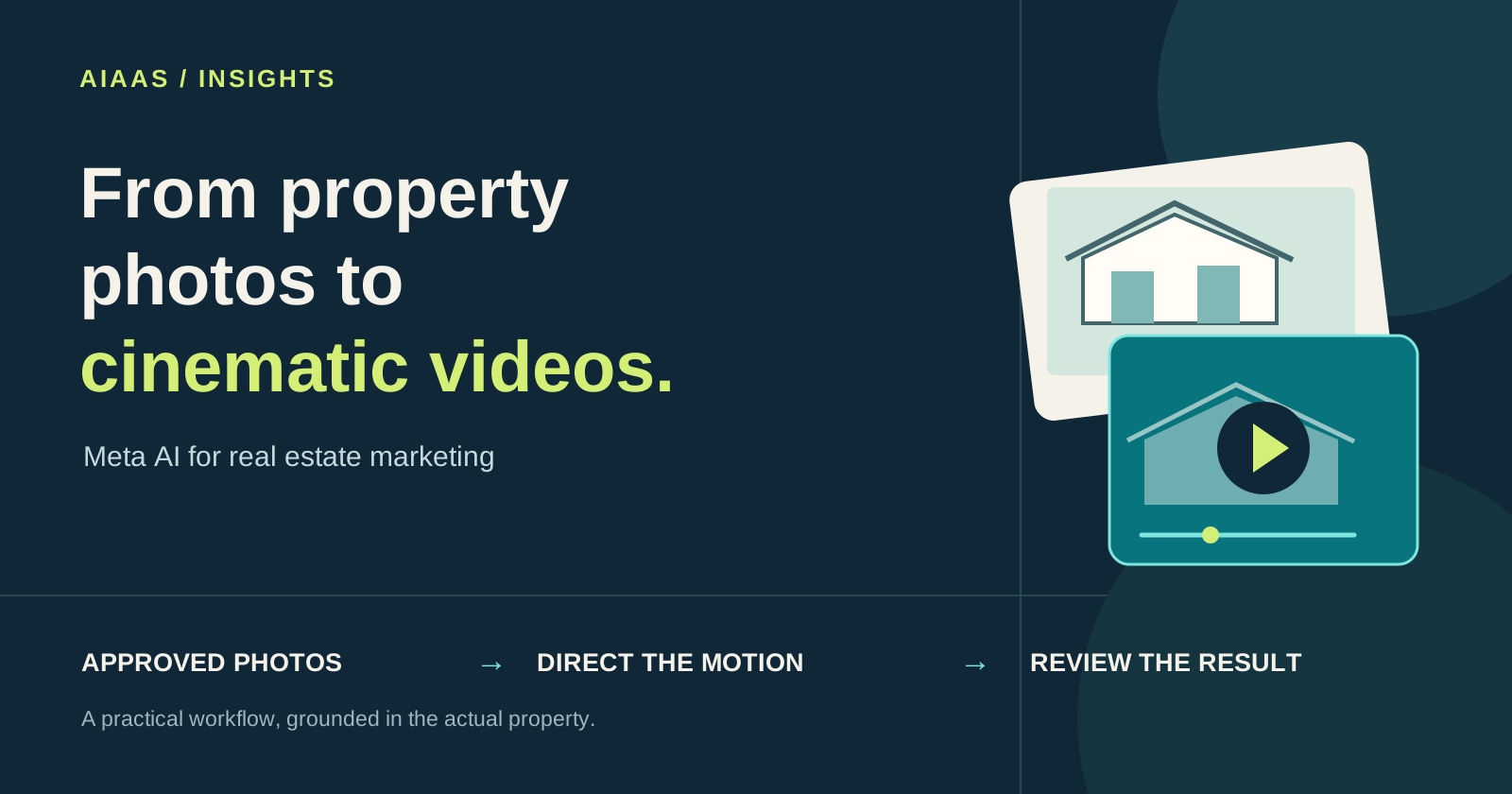
Image-to-video generation gives property marketers another way to explore that presentation. The creative work begins with choosing what the viewer should notice. The approval work begins with checking that the generated footage remains faithful to the property.
The reference: a Goa villa demonstration
In an Instagram Reel from Visionary AI Studio, the creator describes using Meta AI to animate photographs of Villa 87 by ZenAway in North Goa. The caption attributes the cinematic presentation to image-to-video generation, camera movement and prompting, and says no additional video shoot was used. It identifies the work as an independent creative demonstration.
This is a useful example of a proposed production workflow. The caption does not establish production cost, booking performance or the accuracy of every generated detail. Those questions need separate evidence.
The business question it raises is practical: can a property team turn its existing, approved image library into useful promotional footage with an acceptable amount of effort?
What Meta confirms about the tools
Meta’s Vibes overview describes creating videos from text, animating existing images, editing visual styles and remixing creations. It also describes options for music, voiceover, text and lip-synced dialogue. These capabilities support experimentation with short visual stories. [1]
The exact experience should be checked in the account being used. Meta’s official Android listing notes that some features are limited to selected countries and languages and may roll out gradually. Teams in India should verify access, usage limits, costs and applicable terms before committing to a production schedule. [2]
The Reel’s tool attribution comes from its creator. The workflow below is an editorial recommendation. The creator’s exact process has not been independently verified.
Where the business value could emerge
For a villa operator, boutique hotel or property agency, one promising use is extending the value of photography already commissioned. A small set of approved images could become the starting material for several short creative treatments.
A second use is exploring presentation before investing further. A team might compare a calm interior sequence with an outdoor-living sequence, keeping the property and intended audience consistent.
A third is making the brief more precise. Selecting five images forces useful decisions: which features matter, what should the viewer remember, and what should happen next?
These are hypotheses to test. Faster generation alone does not establish lower production cost, stronger enquiries or more bookings.
A practical photo-to-video workflow
Choose one message
Start with a focused purpose, such as introducing the property’s interiors or highlighting an existing outdoor seating area. Select images that support that purpose.
Check the source material
Use current photographs approved for the intended marketing use. Confirm which furnishings, views and amenities are available to guests or buyers.
Plan restrained movement
Assign a purpose to each clip: draw attention to a feature, establish a mood or hold a clear view. Movement that reveals unseen areas deserves particular scrutiny because the photograph does not document what lies beyond its frame.
Generate, compare and reject
Review each result against its source image and verified property information. Check room proportions, doors, windows, furnishings, reflections, views and amenities. Reject clips that materially change what is being marketed.
Assemble the story
Sequence approved clips and add checked copy, branding and audio in the finishing workflow. Separate shots should not imply a connected route through the building unless that connection is verified.
A suggested starting prompt for an interior image is:
Animate this property photograph with a subtle, slow forward camera movement. Preserve the visible architecture, furniture, colours and lighting. Avoid revealing new rooms or adding objects. Keep the movement restrained and the scene natural.
This is a proposed prompt for testing. Instructions to preserve a scene are not a guarantee that the output will do so.
Property accuracy is part of creative quality
A generated camera move can make a room feel convincing without documenting its true geometry. That distinction matters when a viewer is evaluating a stay or a purchase.
Describe the finished asset clearly as an AI-generated visualization based on property photographs. Support decisions about layout, dimensions, amenities and views with verified listing details, authentic imagery and an actual viewing where appropriate.
Review scenic claims carefully. A generated sea view, altered pool or expanded room could change the offer a customer believes they are seeing.
Plan disclosure during production and check the guidance for the intended placement. Meta documents different labeling approaches for organic content and advertising. [3] [4]
Measure usable output
Run a small pilot with one property, a fixed budget and a clear approval standard.
Track total staff time, generation charges, failed attempts and finishing effort. Calculate cost per approved asset using the full production cost. If nothing passes review, record the expenditure as an unsuccessful pilot.
Assess communication as well as appearance: can a reviewer identify the intended message, and does the video accurately represent the property?
If the content is tested with an audience, track a relevant next step such as qualified enquiries or viewing requests. Keep those observations separate from claims about incremental bookings or sales; a small creative test rarely isolates every influence on the result.
The Goa demonstration connects AI video generation to a recognisable property-marketing task. The next useful step for a property business is to test that task against its own source material, accuracy standard and production costs. That is how a cinematic experiment can earn a place in a dependable content workflow.
Sources and reference
- Meta: Vibes product overview — official description of video creation and editing capabilities.
- Meta: Vibes Android app listing — availability and rollout information.
- Meta’s approach to labeling AI-generated content and manipulated media — platform guidance for organic content.
- Meta: Generative AI transparency in advertising products — platform guidance for advertising.
Creative reference: Visionary AI Studio’s Instagram Reel. Property identification and tool attribution follow the creator’s caption. Generation records, source images and performance results were not independently audited.
Sources checked 30 October 2026. The workflow and prompt are Visionary AI Studio’s editorial recommendations. Prepared with AI assistance.