Executive takeaway
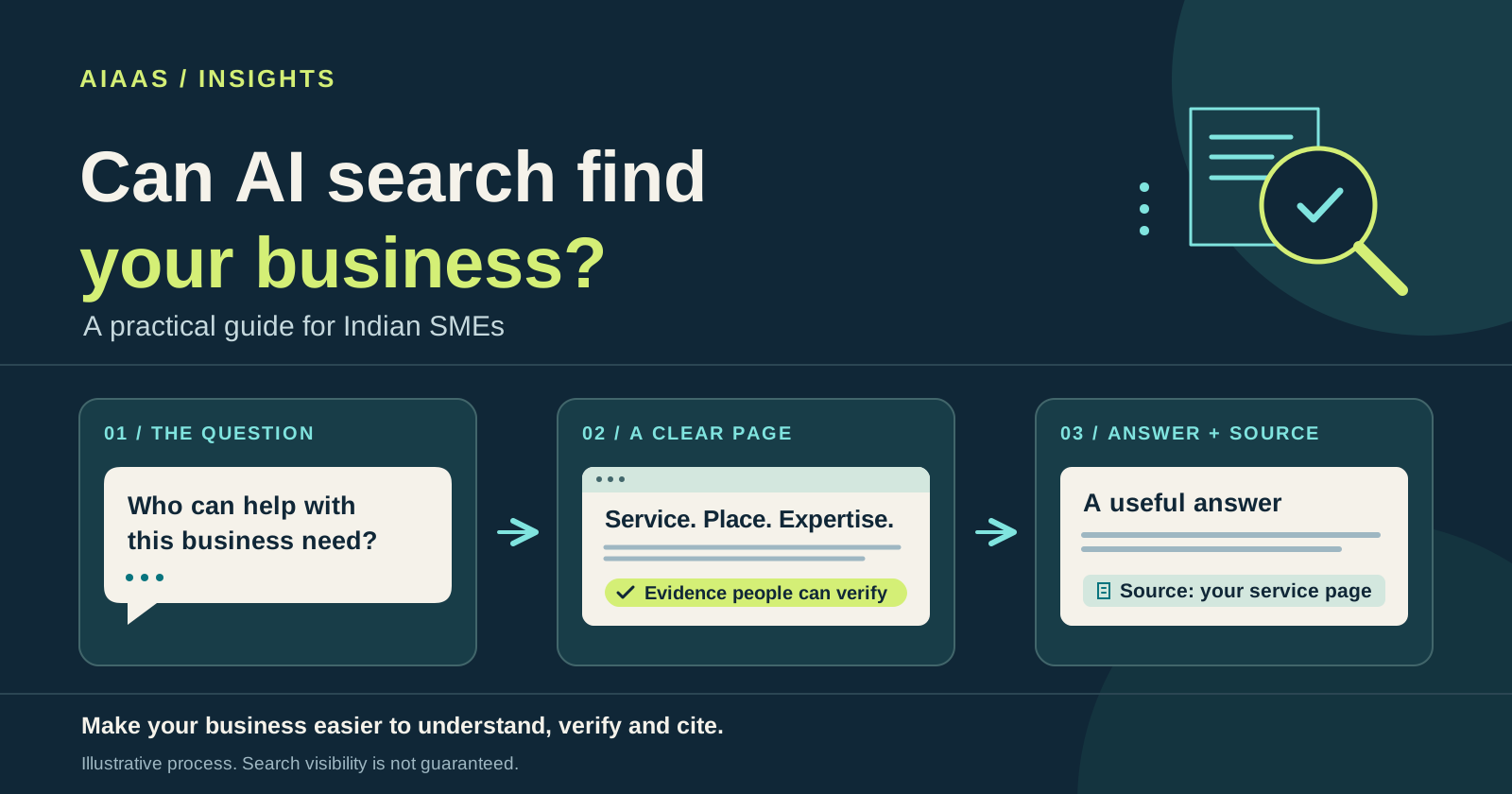
Make your business easier to understand, verify and contact.
Start with the question your customer needs answered
Imagine someone asking Google: “Who services split ACs in Ballygunge, and how will I know the charges before work starts?” A service page saying “best quality at affordable prices” offers little help with that decision.
For an Indian SME, a useful starting question is: does our website explain the work we actually do, for the people and places we actually serve? Answering it creates a manageable project. Choose one important service page and examine the information a prospective customer would need before contacting you.
The aim is a clearer public explanation of your business. An appearance in an AI answer is one possible discovery event; a useful enquiry is a separate business outcome.
What Google’s guidance actually asks for
Google’s generative AI optimization guide, updated 10 July 2026, says established SEO practices remain relevant to AI Overviews and AI Mode. It prioritizes useful, original content and clear technical foundations. It says Google Search requires no special AI markup or llms.txt file. Following its recommendations cannot guarantee indexing or appearance. [1]
First establish access. Google’s technical requirements include an accessible, working page with indexable content; use Search Console’s URL Inspection tool to investigate a specific URL. Eligibility for generative AI features also requires indexing and eligibility for a Search snippet. [2] [1]
Then check participation. In Search Console, review Settings → Search generative AI. Google documents an include option and an inherited setting for child properties. Confirm the effective choice matches your business’s intention; a site excluded through this control cannot appear in the covered AI features. Inclusion is the default for top-level properties. [3]
A fictional Kolkata service page, before and after
Illustrative example: the following appliance-repair business, page copy and proposed changes are fictional. They are not a client case study or evidence of ranking improvement.
Before: “Best AC service in Kolkata. Expert technicians. Affordable rates. Call now.”
The owner replaces the generic pitch with verified operating details:
After: “Split-AC servicing in Ballygunge and selected nearby South Kolkata neighbourhoods. Tell us your location and AC model when requesting a visit. Our team confirms coverage, the visit charge and appointment availability before booking.”
“A service visit includes the agreed inspection and cleaning work. Replacement parts and additional repairs require a separate quotation and your approval. Please ask which tasks are included for your model. An enquiry becomes a confirmed visit after our team checks the schedule.”
The revised page also shows the current contact number, staffed hours, a genuine service photograph used with permission, and a named person responsible for keeping the information current. A short example explains how the team handles a request that falls outside its service area.
Its value comes from specific answers the business can stand behind. The business should publish only details it has verified, including any claims about technician qualifications, warranties or supported brands. Google’s helpful-content guidance emphasizes original value and evidence of relevant experience. [4]
A 10-point checklist for one useful page
This is AIAAS’s proposed working checklist. Use it with the official guidance, then assign each unresolved item to an owner.
- Define the decision. Write down the customer’s question and the service page that should answer it. Start with one commercially important task.
- Check access and indexing. Ask your website owner to inspect the URL in Search Console and investigate blocked access, errors or unintended indexing restrictions. [2]
- Review AI participation. Check the effective Search generative AI control, including inherited settings. Record the choice and the person responsible. [3]
- Explain the actual offer. State service scope, coverage, exclusions, how charges are confirmed and what the customer should prepare. Remove unsupported superlatives.
- Add first-hand value. Include a genuine process explanation, a permitted example or an expert-reviewed answer that reflects how your business works. [4]
- Align business details. Review your official website and, for an eligible local business, its Google Business Profile. Check contact and location information. Google documents these tools for establishing a business presence. [5]
- Use relevant media. Add photographs or a short demonstration that helps explain the service. Obtain permission and describe what the media shows.
- Make the page usable. Check mobile reading, useful headings, working navigation and a contact path that reaches the intended team.
- Keep markup grounded. If structured data is used, have the website owner maintain accurate business details. Google specifies no special schema for generative AI search. [1]
- Assign maintenance and measurement. Name an owner, record the change date and agree how to identify a relevant enquiry. Review information when operations change.
Use English, Bengali or Hindi according to the customers your team can support. Review translations with someone who understands the service. Several useful local-language explanations can serve customers; mass-producing near-identical pages for every locality creates a different project with little original value.
What an honest 30-day review looks like
Days 1–3: Record a baseline. Save the page, business details and available historical Search Console data. Agree on the target page and a qualified-enquiry definition, such as a request for a supported service in the actual coverage area. Record promotions, holidays and staffing changes that could affect comparisons.
Days 4–10: Improve and verify. Publish approved information, check the contact journey and document exactly what changed. Confirm staff can honour the page’s promises. Keep a short list of unanswered customer questions for the next revision.
Days 11–30: Observe. Google now documents a dedicated Generative AI performance report in Search Console. It reports impressions for supported AI search features, with views by page, country, date and device. The report may be absent when a site has insufficient impressions. An impression means a link was shown; it does not establish a visit or sale. [6]
Review normal Search performance and your own enquiry records alongside those impressions. Keep counts separate: AI impressions, website visits, contact actions and qualified enquiries. Do not label every organic visit “AI traffic” or add overlapping reporting totals together.
A manual check can document what a particular search displayed: record the question, date, language and observed sources. AI answers and citations can vary; a screenshot is a sample, not a stable ranking. Google shows AI Overviews when its systems judge them helpful and warns that responses can contain errors. [7]
At day 30, review information quality, technical issues, relevant enquiries and production effort. A small sample or slow indexing may leave the visibility question unresolved. Extend observation where useful. Changes in demand, competitors and other marketing prevent a simple before-and-after comparison from proving that the page revision caused a business result.
Choose the next improvement from real gaps
If callers still ask about coverage, clarify coverage. If they expect an unsupported service, correct the description. If a useful page is inaccessible, resolve access before commissioning more content.
Google’s guidance offers a practical foundation. Build on it with accurate information that answers your customers’ real questions, a working route to your team and a record of what changed. That gives the next decision evidence beyond a single AI citation.
Sources and editorial notes
- Google: Optimizing your website for generative AI features on Google Search — updated 10 July 2026.
- Google Search technical requirements.
- Search Console: Search generative AI control.
- Google: Creating helpful, reliable, people-first content.
- Google: Establish your business details.
- Search Console: Generative AI performance report.
- Google Search Help: AI Overviews.
Sources checked 30 October 2026. The fictional example, checklist and review plan are Visionary AI Studio’s editorial framework. They do not promise search placement or business results. Prepared with AI assistance.