Executive takeaway
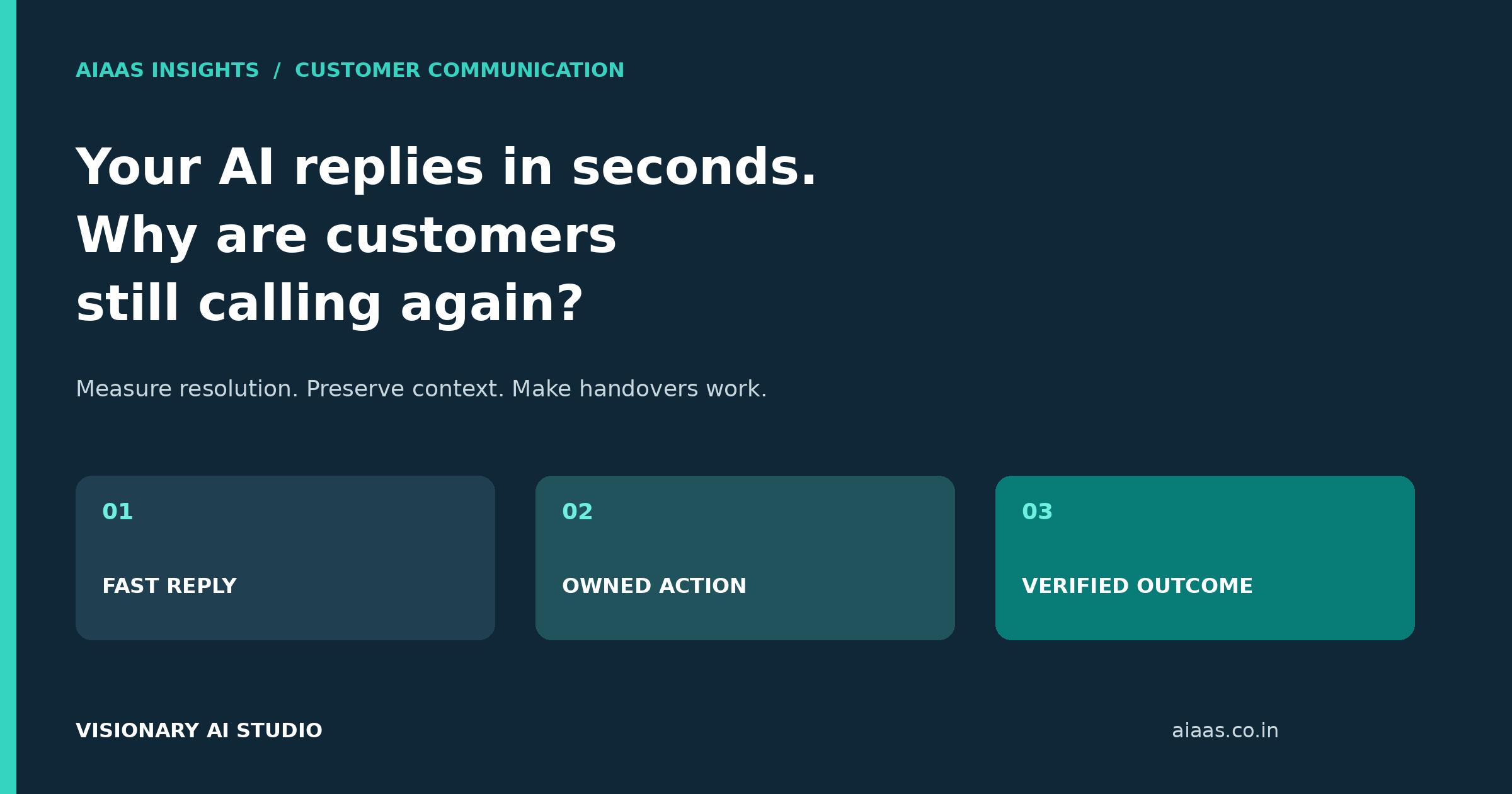
Measure what happens after the conversation ends.
An assistant can reply instantly while a refund remains unprocessed or a repair stays unassigned. Track verified resolution and repeat contacts alongside speed. Give people the context and authority to complete exceptions.
The dashboard is green. The customer is still waiting.
Picture a customer asking on WhatsApp when a technician will arrive. The assistant replies immediately: the team will get in touch. The customer calls the next morning, repeats the story, then sends an email. Every channel records an interaction. Nobody has confirmed the appointment.
This is an illustrative situation, not a client case. It exposes a useful distinction: response means a message was delivered; resolution means the request reached an agreed, verifiable outcome. A closed ticket is insufficient evidence when the booking failed or the customer had to start again.
Define the outcome by request type. A status enquiry may be resolved with accurate information. A repair booking needs a confirmed slot. A refund request may require review and an authorised transaction. Some cases must remain open while another department completes its work.
Our 25-point communication audit examines the wider operation. This guide focuses on the gap between the first reply and the completed service outcome.
Customers welcome help. They also want a way through.
Gartner's August 2026 release reports that 50% of surveyed customers found interactions easier when companies used generative AI, while 87% considered the option to reach a human essential. Its survey covered 3,566 B2B and B2C customers in February and March 2026. [1]
Qualtrics found that nearly one in five consumers who had used AI customer service reported no benefit. The Q3 2025 study behind its 2026 Consumer Experience Trends report surveyed more than 20,000 consumers across 14 countries, excluding India. Treat this as an experience-design warning, not an Indian failure-rate benchmark. [2]
There is evidence of benefits too. Salesforce's May 2026 release reports that customer satisfaction was the most improved KPI reported by service organisations after deploying AI agents. Its survey gathered 3,075 service-professional responses across four regions. This is provider-published, self-reported evidence rather than a controlled experiment. [3]
These studies ask different questions of different populations. They cannot establish a combined success rate. Our practical conclusion is to test your own journey: information, action capability and escalation design all need to work.
Repair the journey before adding more automation
Consider a fictional Kolkata appliance retailer. A Bengali-speaking customer wants to reschedule an open repair request. The assistant can retrieve authorised ticket information, but a revised slot requires dispatch approval.
| Stage | A weak journey | A better design |
|---|---|---|
| Identify | Ask for every detail again. | Verify identity through the approved process and locate the existing case. |
| Understand | Return a generic FAQ. | Recognise the request to change an existing appointment. |
| Act or route | Promise a callback without an owner. | Check supported scheduling capability; otherwise assign dispatch the requested slot. |
| Hand over | The next person starts from zero. | Transfer verified facts, actions tried and the unresolved request. |
| Confirm | Close the chat after a reply. | Confirm only after dispatch accepts the slot; record evidence of the defined outcome. |
If the scheduling integration does not exist, describe the request as pending. Do not invent a slot or claim the booking changed. A named person can complete the action during a manual pilot; automation follows after access, permissions and error handling are tested.
“Your existing repair request is open. I have passed your preferred appointment to dispatch. The slot is not confirmed yet. You can speak to the service team, or use this case reference to check progress.”
This illustrative message is appropriate only when those facts and actions are verified. Include a callback time only when the responsible team has accepted it. Clear wording supports completion; it cannot replace the underlying action.
A human handover should carry the work forward
Define escalation by request type and consequence. A model saying it is confident does not verify its answer.
- A customer asks for a person: offer the supported route promptly, with honest availability and waiting information.
- Information conflicts or is missing: refer to the source owner before making commitments.
- An attempt fails again: stop the loop and assign the unresolved case.
- An action exceeds permission: send refunds, exceptions or restricted changes to an authorised person.
- A system action fails: preserve the case, log the result and explain what remains pending.
Transfer the verified case reference, intent, relevant facts, actions attempted, unresolved question, preferred language and next owner. Expose only information the receiving person needs. Conversation access must not grant unrestricted customer-record access.
HANDOVER CARD
Case reference: [verified identifier]
Customer wants: [specific outcome]
Verified facts: [source and relevant details]
Actions attempted: [actual results, including failures]
Still unresolved: [question or action]
Owner / queue: [assigned recipient]
Next update: [accepted commitment, or pending]
Language: [customer preference]
Approval needed: [yes/no and reason]
Outside staffed hours, explain when support resumes and what the customer can do now. Do not imply a live agent is available when no one is on duty. The receiving queue should acknowledge ownership rather than simply receive a notification.
Five measures to put beside first-response time
Choose one request category and define “resolved” before testing. Link permitted channels through a case identifier. Use a stated observation window: seven days is an illustrative starting point, not a universal rule.
| Measure | Method | Interpretation |
|---|---|---|
| Verified resolution rate | Cases meeting the defined outcome ÷ eligible cases in a cohort whose observation window has ended. | Use action records, customer confirmation or reviewed evidence. Show open cases separately. |
| Repeat-contact rate | Cases with another inbound contact about the same unresolved issue within the window ÷ eligible cases. | Exclude planned updates and unrelated new requests. |
| Customer effort | Ask how easy it was to get the issue resolved, using the same scale before and during the pilot. | Report response count and rate; nonrespondents may have different experiences. |
| Handover quality | Reviewed transfers with an owner, sufficient verified context and an actionable next step ÷ transfers reviewed. | Check receiving-queue acceptance as well as packet completeness. |
| Cost per resolved case | Total attributable service cost for the cohort ÷ verified resolved cases. | Include repeated contacts, human work, AI usage and allocated operating costs. |
Monitor total time to resolution, incorrect answers, failed actions and complaint escalations too. A low repeat-contact rate can reflect abandonment: examine it alongside verified outcomes and customer feedback. Lower handling time alone does not prove better service.
Why a cheap conversation can become an expensive case
Suppose a baseline cohort has 100 eligible cases, costs ₹12,000 to service and produces 80 verified resolutions. Cost per resolved case is ₹150. A pilot cohort of 100 comparable cases costs ₹13,000, including attributable AI charges and human work, and produces 95 verified resolutions. Its cost per resolved case is approximately ₹136.84.
In this fictional arithmetic example, total spending rises by ₹1,000 while cost per completed outcome falls by about 8.8%. This does not prove cash savings, retention or extra revenue. It shows why completion and total spend should be examined together.
Hold request mix, observation window and cost allocation consistent. Include integration, training and maintenance in the wider business case. Use comparable concurrent groups where practical: a quiet week or easier workload can otherwise create an apparent improvement. See our AI ROI scorecard for the broader evaluation.
A 30-day pilot with a bounded decision
- Week 1 — baseline. Select one recurring category, review representative journeys, classify repeat contacts and define outcome evidence. Name a business owner.
- Week 2 — repair. Check source information, permissions, escalation triggers and receiving queues. Test incomplete inputs and failed actions.
- Week 3 — limited workload. Use AI for approved tasks with human review where needed. Record attempted actions and failures. Test relevant English, Hindi or Bengali scenarios with a qualified reviewer.
- Week 4 — decision. Let the measured cohort's observation window finish. Review all five metrics and failure cases. Expand, repair or stop based on agreed criteria.
A small pilot can reveal failures and estimate effort; it may not establish statistically reliable improvement. Set thresholds before testing, report sample sizes and extend observation for open cases. Expansion requires evidence that permissions, action verification and exceptions work.
Start your next service review with this question: “Of the customers we answered last week, whose problem did we actually finish?”
Questions business owners ask
Should every customer speak to AI first?
Choose by task and customer need. A routine status check may suit automation; a disputed decision or repeated failure may need a person. Preserve usable human access.
Can we test this without a new CRM?
Yes, if your existing systems or an approved tracker can lawfully link cases and record outcomes. That supports a manual pilot. Live integrations and automated actions need separate implementation and testing.
Does this guarantee fewer calls?
No. Volume can rise with growth or better access. Measure avoidable contacts about unresolved work while maintaining service quality and access.
Sources and editorial notes
- Gartner: human access in generative AI customer service — 4 August 2026; 3,566 customers surveyed February–March 2026.
- Qualtrics: 2026 Consumer Experience Trends findings — release dated 7 October 2025; Q3 2025 consumer study across 14 countries, excluding India.
- Salesforce: State of Service, AI Agents Edition findings — 20 May 2026; survey conducted 9 March–4 April 2026 with 3,075 service-professional responses.
Sources checked 4 October 2026. The workflow, handover card and scorecard are Visionary AI Studio's proposed practical framework. The retailer and cost example are fictional, not client results or promised returns. Research findings do not establish Indian SME benchmarks. Prepared with AI assistance and editorial review.